
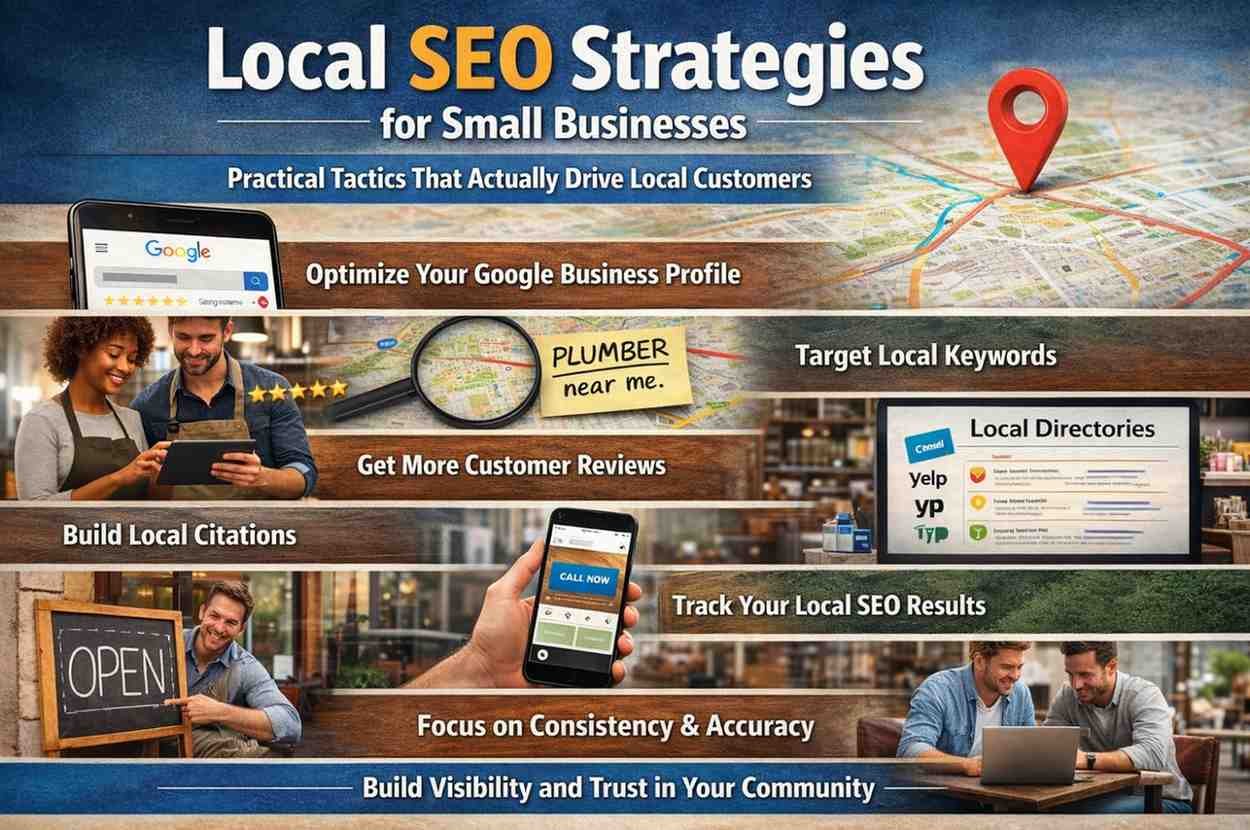
When people search for local SEO strategies for small businesses, they are usually not chasing theory. They want customers to find them, call them, walk into their store, or book their service. We have worked with small businesses that had great services but stayed invisible simply because their local signals were weak, inconsistent, or ignored. This guide focuses on what truly moves the needle locally, based on patterns we have seen work repeatedly—not guesswork.
Why Small Businesses Struggle to Show Up in Local Search Results
Most small businesses fail at local SEO because they treat it like traditional SEO. Local search is far more sensitive to accuracy, proximity, and trust signals. We have seen businesses with strong websites lose visibility because their address was inconsistent or their reviews were unmanaged. Local SEO rewards operational discipline more than flashy tactics. Small mistakes compound fast at the local level, especially in competitive service areas.
How Google Actually Evaluates Local Businesses
Google does not guess. It verifies. Local rankings depend heavily on relevance, distance, and prominence. Prominence is where small businesses can compete if done right. Consistent business data, real customer engagement, and location-specific relevance matter more than backlinks alone. Google Business Profiles are often the deciding factor, not the homepage. Understanding this changes how resources should be allocated.
Optimizing Google Business Profile Beyond the Basics
Most businesses claim their profile and stop there. That is rarely enough. Profile optimization means regular updates, accurate service categories, keyword-aware descriptions, and fresh photos that reflect real operations. We recommend reviewing official guidance from Google Business Profile optimization to align updates with how Google validates activity. Profiles that stay active consistently outperform those that remain static.
Choosing the Right Local Keywords That Convert
Local keywords are not about volume alone. “Emergency plumber near me” converts better than a high-volume generic term. We prioritize intent-based phrases tied to services and neighborhoods. This approach reduces traffic waste and improves call quality. Long-tail local keywords often bring fewer visitors but significantly higher conversion rates. Precision wins locally.
Building Location-Specific Pages Without Overdoing It
Location pages should exist for users, not search engines. We have seen businesses tank in rankings by duplicating the same page for every city. Effective pages include unique context, local examples, service nuances, and embedded maps. Each page should feel written by someone who actually works in that area. Thin location pages are worse than none at all.
Why Reviews Are a Ranking and Conversion Engine
Reviews influence both visibility and trust. We have watched rankings improve simply by responding thoughtfully to reviews—positive and negative. Review velocity matters more than sheer volume. Businesses that collect steady feedback look alive to search engines. Platforms like Moz local SEO research confirm that review signals strongly correlate with local pack visibility.
Handling Negative Reviews Without Losing Authority
Negative reviews are unavoidable. Ignoring them is the real mistake. Professional responses show accountability and often reverse customer perception. We advise addressing the issue publicly, then taking the conversation offline. Search engines and users both reward businesses that handle criticism responsibly. Silence signals neglect.
Local Citations That Actually Matter
Not all citations are equal. We focus on accuracy over quantity. Core directories, industry-specific platforms, and regional listings carry the most weight. Inconsistent NAP (name, address, phone) data erodes trust quickly. Regular audits prevent ranking erosion caused by outdated listings created years ago and forgotten.
On-Page SEO Tweaks That Boost Local Relevance
Local SEO does not require reinventing your website. Simple improvements—like adding service areas to headers, embedding maps, and including local testimonials—create stronger relevance signals. We also optimize title tags to reflect service + location naturally. Subtle changes often outperform complete redesigns.
Mobile Experience as a Local Ranking Factor
Local searches are mobile-heavy and action-driven. Slow load times or cluttered layouts kill conversions. We prioritize click-to-call buttons, readable layouts, and fast-loading pages. If users struggle on mobile, rankings suffer indirectly through poor engagement metrics. Local SEO and UX are inseparable.
Local Link Building That Feels Natural
Local links come from relationships, not outreach templates. Sponsoring events, collaborating with nearby businesses, and earning mentions in local publications work better than generic guest posts. These links reinforce geographic relevance, which national backlinks often fail to do. Local trust compounds over time.
Tracking Local SEO Performance the Right Way
Rankings alone are misleading. We track calls, direction requests, form submissions, and review growth. These metrics reflect real business impact. Local SEO success is measured in customers, not just positions. Data should inform adjustments, not inflate reports.
Common Local SEO Mistakes We See Repeatedly
Keyword stuffing business names, fake addresses, and duplicate listings eventually backfire. Short-term gains lead to long-term penalties. Sustainable local SEO favors transparency and consistency. Cutting corners locally is riskier than in traditional SEO.
How Long Local SEO Takes to Show Results
Local SEO is not instant, but it is faster than many expect. We often see movement within 30–60 days when fundamentals are fixed. Competitive markets take longer, but progress is measurable early. Patience paired with consistency delivers predictable results.
Summary: What Actually Works in Local SEO
Local SEO works when it mirrors real-world operations. Accuracy, consistency, responsiveness, and relevance outperform shortcuts. Small businesses that treat local SEO as an extension of customer service—not a marketing trick—build durable visibility that competitors struggle to displace.
